

Miami's Shift Toward Preventive Wellness and Longevity Medicine
Discover Miami's shift toward preventive wellness and longevity medicine, including metabolic health, hormones, healthy aging, and personalized care.
Discover Miami's shift toward preventive wellness and longevity medicine, including metabolic health, hormones, healthy aging, and personalized care.

Miami has always been a city where health, fitness, beauty, and lifestyle intersect. From early morning workouts along the waterfront to the growing interest in nutrition, metabolic health, and wellness, taking care of yourself has become an important part of South Florida's culture.
But the conversation around health is evolving.
Instead of focusing exclusively on looking younger or addressing symptoms after they appear, more people are exploring how to stay healthier as they age.
This growing interest in preventive wellness and longevity medicine reflects a broader shift in how people think about their health. The focus is moving beyond short-term results toward understanding long-term health risks, maintaining physical function, and making informed decisions earlier in life.
For residents of Miami, Doral, and surrounding South Florida communities, this raises an important question: What does proactive healthcare actually look like, and which approaches are supported by medical evidence?
Preventive wellness focuses on maintaining health, identifying risk factors, and addressing potential concerns before they develop into more serious problems.
Rather than waiting until symptoms interfere with everyday life, preventive healthcare encourages appropriate screenings, regular medical evaluations, and healthy lifestyle habits.
Depending on an individual's age, medical history, and risk factors, preventive care may involve:
Preventive care isn't about finding something wrong with every patient. It's about understanding individual risks and taking reasonable steps to support long-term health.
Longevity medicine is a term increasingly used to describe healthcare approaches focused on healthy aging, disease prevention, and maintaining function later in life.
An important concept in this conversation is the difference between lifespan and healthspan.
Lifespan refers to how long someone lives. Healthspan refers to the years a person spends in relatively good health, maintaining independence and physical and cognitive function.
While no medical treatment can guarantee a longer life, many established preventive healthcare strategies can help reduce the risk of certain chronic diseases.
The challenge is distinguishing evidence-based medical care from newer wellness trends that may promise more than research currently supports.
Miami's strong fitness, aesthetics, and wellness culture provides a natural setting for conversations about healthy aging.
Interest in preventive medicine also fits into several broader changes in how people approach healthcare.
For many adults, healthy aging isn't simply about reaching a certain age.
It's about maintaining the ability to exercise, travel, work, enjoy family activities, and remain independent.
Muscle strength, cardiovascular fitness, mobility, bone health, and metabolic health can all influence quality of life as people get older.
This has encouraged greater interest in healthcare strategies that support long-term physical function rather than focusing exclusively on appearance.
Blood sugar, insulin resistance, cholesterol, blood pressure, and body composition are increasingly common topics in wellness conversations.
These factors matter because metabolic conditions can develop gradually, sometimes without obvious symptoms.
For example, someone may feel healthy while having elevated blood pressure or blood glucose.
Appropriate screening can help identify certain risk factors and provide an opportunity for earlier medical intervention when needed.
Hormones are another major area of interest, particularly among adults navigating changes in energy, sleep, weight, reproductive health, and body composition.
For women, perimenopause and menopause may bring changes that affect everyday life.
For men, concerns about testosterone and age-related hormonal changes are frequently discussed.
However, not every symptom associated with aging is caused by hormones, and hormone testing or treatment isn't automatically necessary simply because someone has reached a particular age.
A physician-led evaluation helps determine whether symptoms suggest an endocrine condition or another medical concern.
Wearable devices, fitness trackers, continuous glucose monitors, and other consumer health technologies have made health data more accessible.
People can now monitor aspects of their sleep, activity, heart rate, and other measurements from their phones.
These tools may encourage greater awareness of daily habits, but the information they provide has limitations.
Consumer health data should not automatically be interpreted as a medical diagnosis. Abnormal readings or persistent concerns should be discussed with a qualified healthcare professional.
One of the most discussed areas of longevity medicine is biomarker testing.
Biomarkers are measurable indicators that provide information about biological processes or aspects of health.
Common examples include:
Not every person needs all of these tests, and blood pressure is measured differently from laboratory biomarkers.
The important question isn't how many biomarkers you can track. It's whether the measurements are relevant to your health and whether the results can meaningfully inform medical decisions.
Hormones play essential roles throughout the body, influencing metabolism, reproductive function, bone health, and many other processes.
As people age, certain hormone levels naturally change.
For women, the transition to menopause involves changes in ovarian function and reproductive hormones. These changes may be associated with hot flashes, sleep disturbances, vaginal symptoms, and other concerns.
For men, testosterone levels may decline gradually with age, although testosterone deficiency requires appropriate clinical evaluation and cannot be diagnosed based on age or fatigue alone.
Thyroid disorders and other endocrine conditions can also produce symptoms that overlap with common concerns about aging.
This is where endocrinology can play an important role.
Rather than assuming that every symptom requires hormone replacement or supplementation, an endocrinologist can evaluate whether an underlying hormonal condition is present and whether treatment is medically appropriate.
Weight management has traditionally been discussed in terms of diet, exercise, and appearance.
Today, there's greater awareness that body weight is influenced by multiple factors, including genetics, nutrition, physical activity, medications, sleep, medical conditions, and metabolic health.
Obesity is also recognized as a chronic disease that can require ongoing medical management.
Prescription medications such as Wegovy, Zepbound, Ozempic, and Mounjaro have contributed to broader public interest in metabolic health.
These medications have different FDA-approved indications and are not interchangeable. They may be appropriate for certain patients, but they also have contraindications, potential side effects, and monitoring considerations.
The larger point is that weight management should be approached as a health issue rather than simply an aesthetic goal.
For some individuals, a comprehensive medical evaluation may help identify factors contributing to weight-related health concerns.
Longevity conversations in Miami also frequently include topics such as peptides, NAD+ therapies, supplements, and other interventions marketed for anti-aging.
While some of these areas are being investigated in research, the quality and strength of evidence vary considerably.
It's important to distinguish between an established, FDA-approved medication used for a specific medical indication and an experimental or unapproved intervention marketed for general wellness or longevity.
For example, some peptide-based medications have well-established medical uses, but that doesn't mean all peptides promoted for anti-aging are proven safe or effective.
Similarly, interest in NAD+ and related interventions does not establish that these therapies extend human lifespan or prevent age-related diseases.
Patients should be cautious about treatments promising dramatic rejuvenation, guaranteed results, or biological age reversal.
Preventive medicine should be guided by clinical evidence, not marketing claims.
One misconception surrounding longevity medicine is that more laboratory testing automatically leads to better healthcare.
Some wellness programs promote extensive panels measuring dozens of hormones, inflammatory markers, nutrients, and other biomarkers.
Certain tests may be valuable for specific patients, but testing without a clear clinical reason can sometimes produce confusing results, unnecessary follow-up procedures, or additional expenses.
A laboratory value outside a reference range doesn't always indicate disease.
Likewise, a normal laboratory result doesn't necessarily explain every symptom someone may be experiencing.
A qualified healthcare provider can help determine which tests are appropriate and interpret results in the context of the patient's medical history.
Despite the growing interest in advanced diagnostics and longevity technology, many of the most important components of healthy aging remain familiar.
Regular physical activity supports cardiovascular health, mobility, and overall function.
Resistance training is particularly valuable for maintaining muscle strength as people age.
Consistent, adequate sleep supports multiple aspects of health, including cognitive function, metabolic regulation, and daily performance.
Persistent sleep problems may warrant medical evaluation.
A balanced eating pattern that provides appropriate nutrients and supports individual health needs remains an important part of preventive care.
There is no single diet that guarantees longevity.
Blood pressure, cholesterol, blood glucose, and other risk factors may require monitoring based on individual circumstances.
Recommended cancer screenings, vaccinations, and routine preventive evaluations are important components of evidence-based healthcare.
Managing diagnosed conditions such as diabetes, hypertension, thyroid disorders, and other chronic illnesses can be an important part of supporting long-term health.
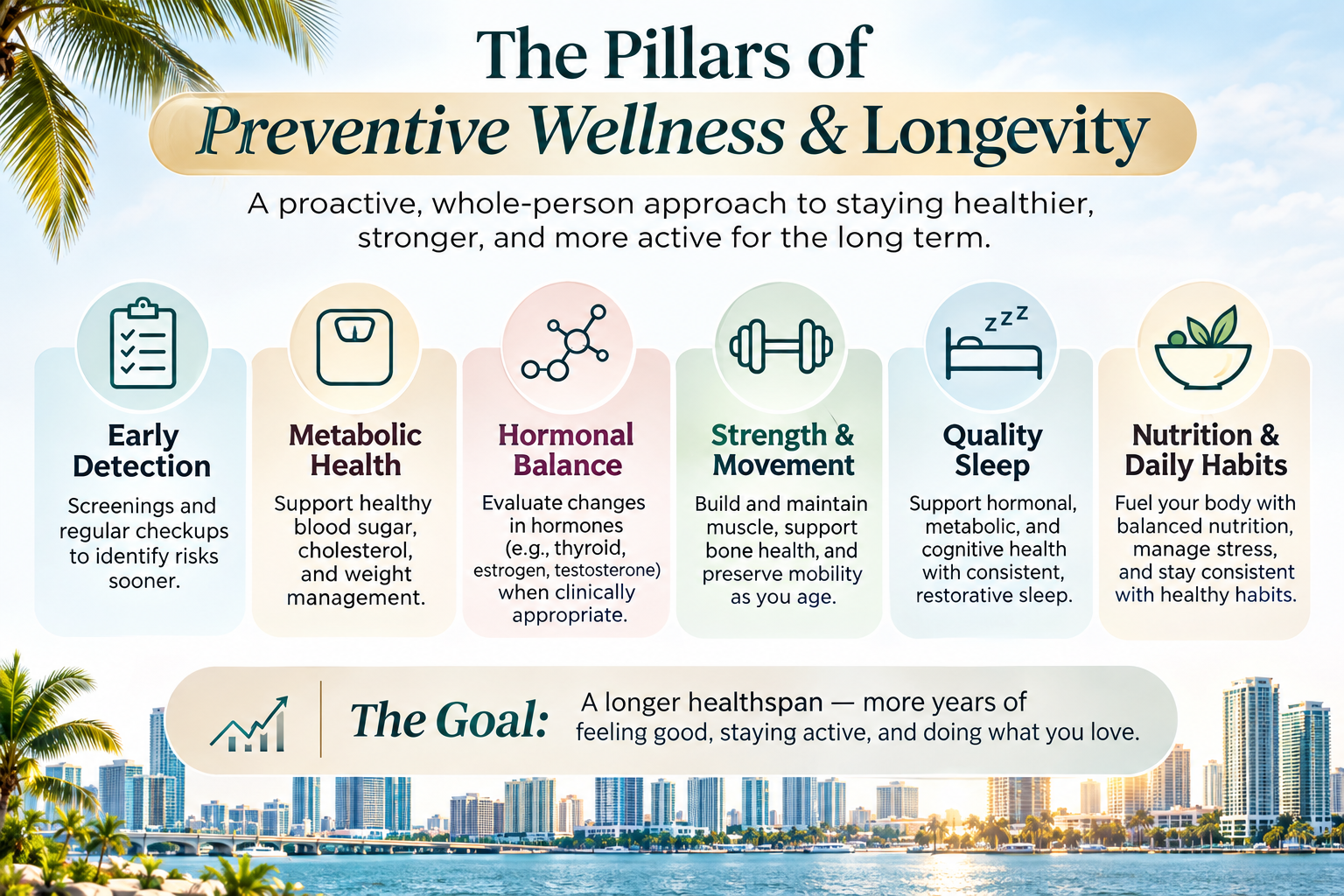
As interest in preventive wellness continues to grow, personalized medical care remains an important part of making informed health decisions.
At GLANZ Endocrinology, Aesthetics & Wellness in Doral, Florida, Dr. Linette Rivera provides individualized evaluations for patients with hormonal, thyroid, and metabolic health concerns.
Rather than approaching wellness through a one-size-fits-all protocol, Dr. Rivera considers each patient's symptoms, medical history, medications, lifestyle, risk factors, and laboratory findings when appropriate.
This approach helps determine whether additional endocrine or metabolic evaluation is necessary and which care options may be medically appropriate.
For patients throughout Doral, Miami, Miami-Dade County, and surrounding South Florida communities, physician-led endocrine care can be an important component of a broader approach to long-term health.
Miami's interest in preventive wellness reflects an important idea: taking care of your health shouldn't begin only when something goes wrong.
But longevity medicine doesn't have to involve expensive testing, complicated protocols, or experimental treatments.
For many people, the most meaningful starting point is understanding their individual health risks, following appropriate preventive screening recommendations, maintaining sustainable habits, and addressing medical concerns when they arise.
Healthy aging isn't about achieving perfect laboratory numbers or avoiding every natural change associated with getting older.
It's about making informed decisions that support your health, independence, and quality of life over time.
If you have concerns about your metabolic, thyroid, or hormonal health, schedule a consultation with Dr. Linette Rivera at GLANZ Endocrinology, Aesthetics & Wellness in Doral, FL.
Call (305) 434-8358 to learn more or schedule an appointment.
Preventive medicine focuses on reducing disease risk, identifying health concerns early, and maintaining health through evidence-based screening and care. Longevity medicine generally emphasizes healthy aging, maintaining function, and reducing age-related health risks, although the term is used differently across healthcare and wellness settings.
Healthy habits and appropriate preventive healthcare are valuable throughout adulthood. There is no specific age when everyone needs a longevity evaluation. Screening and medical recommendations should reflect individual risk factors and health history.
Commonly monitored measurements include blood pressure, cholesterol, and blood glucose or A1C. Other tests may be appropriate depending on symptoms, medical history, and individual risk factors.
Hormone therapy is not established as a general treatment for extending human lifespan. Certain hormone therapies have specific medical indications and may be appropriate for selected patients following individualized evaluation.
There is currently insufficient clinical evidence to conclude that peptides marketed for general anti-aging or NAD+ therapies reliably slow human aging or extend lifespan. Evidence varies by compound, formulation, and intended medical use.
An endocrinologist may be appropriate when symptoms, laboratory findings, or medical history suggest a hormonal, thyroid, or metabolic concern. Routine preventive care can also involve primary care physicians and other healthcare professionals.
GLANZ Endocrinology, Aesthetics & Wellness in Doral provides individualized endocrine and metabolic evaluations with Dr. Linette Rivera. Patients can call (305) 434-8358 to inquire about appointments.
Disclaimer: This article is intended for educational purposes only and does not replace individualized medical advice, diagnosis, or treatment. Preventive screenings, laboratory testing, medications, and other medical interventions should be selected based on individual clinical circumstances in consultation with a qualified healthcare professional.

At Glanz, we specialize in comprehensive endocrinology care, focusing on the diagnosis, treatment, and management of a wide range of hormonal and metabolic conditions. Our experienced endocrinologists are dedicated to providing personalized care that helps restore balance to your body’s endocrine system, which plays a vital role in regulating metabolism, growth, and development.